

The ship that laid the first lasting transatlantic telegraph cable - and changed how the world communicates.
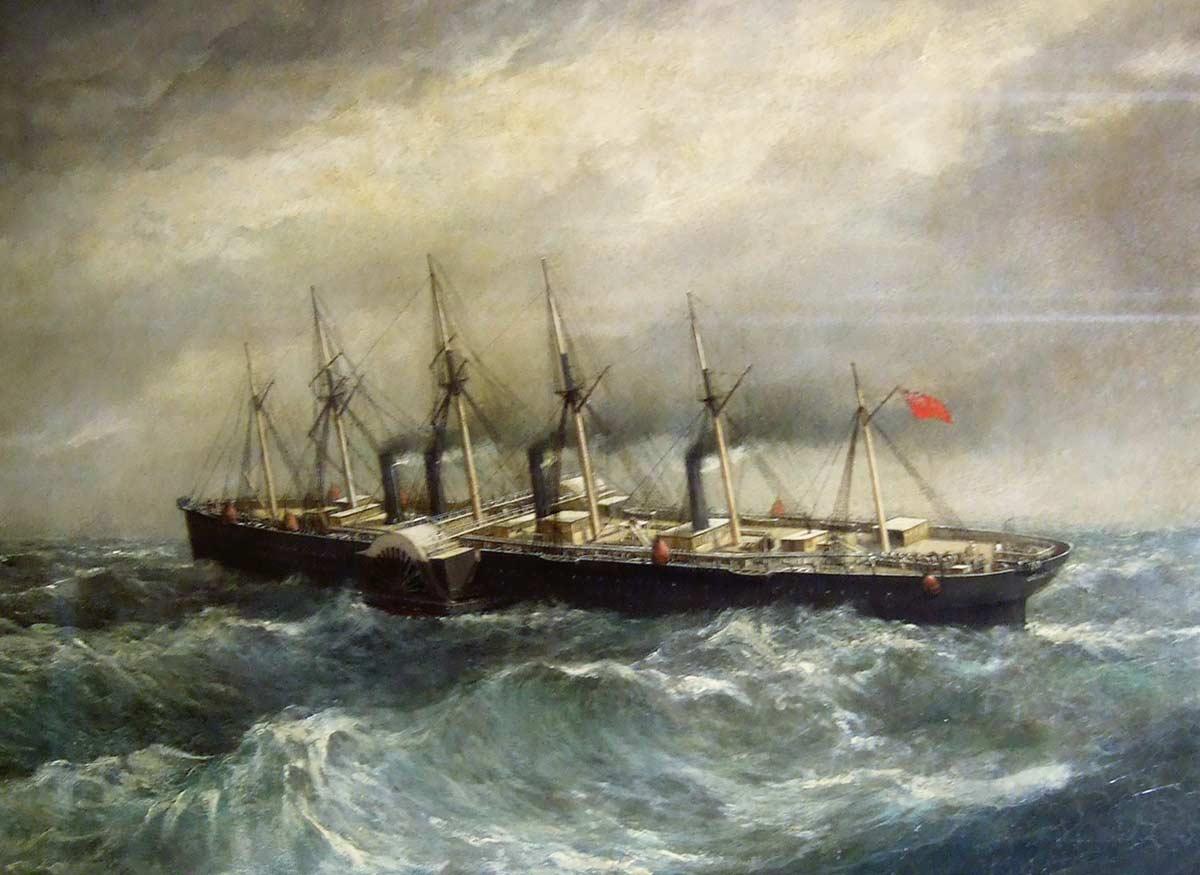
Designed by the engineer Isambard Kingdom Brunel and built by J. Scott Russell & Co. at Millwall, the Great Eastern was launched in January 1858 and completed her maiden voyage in 1859. At roughly 692 feet long, she was by far the largest ship ever built at the time, a record she would hold for nearly fifty years.
Brunel had originally conceived the ship as a passenger liner capable of steaming to Australia and back without refuelling. That commercial career never took hold, but her enormous cargo capacity later made her the only vessel afloat capable of carrying an entire transatlantic telegraph cable in a single load.
1865: The Cable Breaks
In 1865, the Great Eastern set out to lay a telegraph cable across the Atlantic between Ireland and Newfoundland. Roughly two-thirds of the way across, the cable snapped and was lost to the seabed. The expedition was forced to abandon the attempt, though the crew made several unsuccessful efforts to grapple and recover the broken line.
1866: Success, and a Recovery
The following year, the Great Eastern returned with an improved cable and completed the crossing, establishing the first reliable telegraph connection between Europe and North America. She then went back out to sea, grappled the 1865 cable from the ocean floor, spliced it, and completed that line as well - leaving two working transatlantic cables where there had been none.
The achievement transformed transatlantic communication, cutting messages that once took roughly two weeks to arrive by ship down to a matter of hours. It set the template for the submarine cable industry that followed, and the vessel's cable-laying work remains her best-remembered legacy.
Vessel Profile
- Designer Isambard Kingdom Brunel
- Builder J. Scott Russell & Co., Millwall
- Launched 31 January 1858
- Length 692 ft (211 m)
- Original name Leviathan
- Out of service Scrapped, 1889-90
Three Voyages, One Mission
The Cable Is Lost
Roughly 1,200 miles into the crossing, the cable snaps and sinks over two miles to the seabed. Recovery attempts fail and the expedition returns to Britain.
The Line Is Completed
With a stronger cable and lessons learned, the Great Eastern completes the crossing, opening the first dependable telegraph link between Europe and North America.
The 1865 Cable Is Recovered
The ship returns to the site of the previous year's failure, grapples the lost cable from the ocean floor, splices it, and brings a second working line into service.